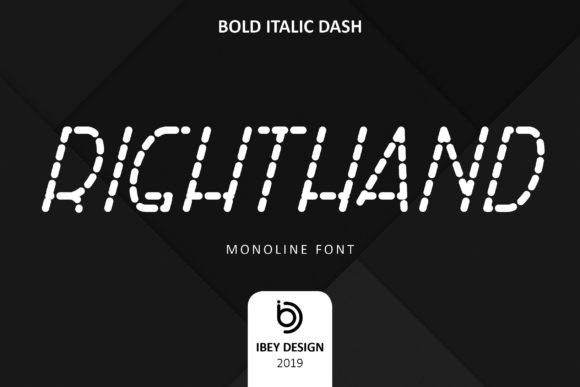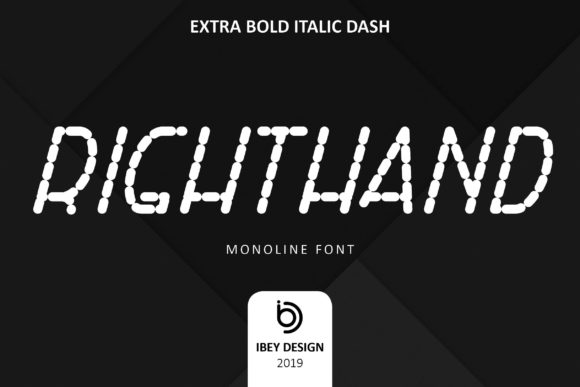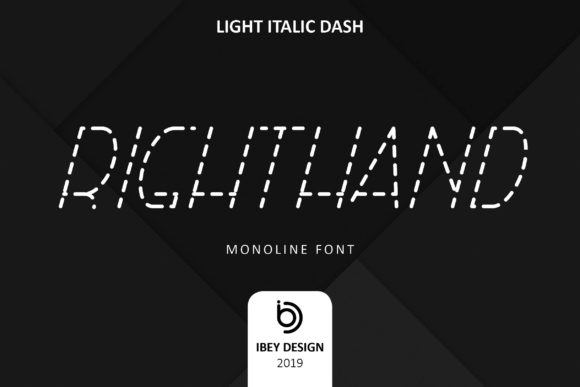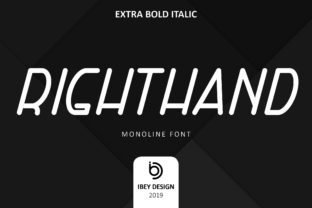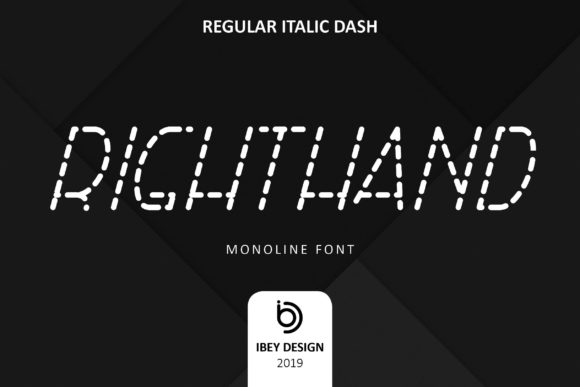
Right Hand Italic Dash
Right Hand Italic Dash is a refined, modern monoline font—clean, confident, and intentionally understated. Unlike decorative scripts or heavy display faces, it draws attention through subtlety: a single consistent stroke weight, gentle italic slant, and subtle dash-like terminals that lend rhythm without clutter. It’s not flashy—but that’s precisely why designers, photographers, small business owners, and content creators reach for it when clarity, elegance, and quiet authority matter.
Why It Fits So Many Real-World Uses
Its monoline construction makes Right Hand Italic Dash exceptionally legible at small sizes—ideal for product labels, packaging copy, or watermark overlays on photography. The italic angle adds movement without sacrificing readability, giving social media quotes, event invitations, or brand slogans a touch of sophistication without pretension. Because it avoids extreme contrast or exaggerated flourishes, it pairs effortlessly with sans-serifs, serifs, and even geometric typefaces—making it a reliable workhorse in branding systems, not just a one-off accent.
A Common Misstep: Assuming “Monoline” Means “One-Size-Fits-All”
Some users download Right Hand Italic Dash expecting it to behave like a universal script—suitable for body text, headlines, logos, and embroidery all at once. But monoline fonts have natural limits. Their uniform stroke weight means they lack the optical compensation built into text fonts (like subtle stroke modulation or adjusted spacing for lowercase ‘e’ or ‘a’). As a result, using it for long paragraphs or dense captions can fatigue readers—even if it looks beautiful in isolation.
Better approach: Reserve Right Hand Italic Dash for short-form, high-impact applications—logos, taglines, photo credits, Instagram story text, or engraved stationery. For longer content, pair it with a highly legible, well-hinted sans-serif (like Inter, Lato, or Montserrat) that shares its warmth and proportion.
Overlooking the Dash Terminal—And What It Actually Does
The “Dash” in Right Hand Italic Dash isn’t just stylistic flair—it’s functional design. Those shortened, tapered terminals create breathing room between letters, helping prevent visual crowding—especially at smaller sizes or on low-resolution screens. But this benefit disappears if tracking is set too tight or line height too compressed.
Example: A small business owner uses Right Hand Italic Dash for product labels on artisanal soap packaging. They reduce letter-spacing by 50 units to “fit more text,” unintentionally causing the dash terminals to visually collide. The result? A cramped, uneven appearance that undermines the handmade, thoughtful brand identity.
What to check before applying it: Preview at actual size—not just on screen, but printed or mocked up on the final medium. Adjust tracking incrementally (start at +20–+40 for 12–16pt use), and always test against your background color and texture. A light gray on kraft paper behaves very differently than white on matte black.
Mistaking “Free Download” for “Ready-to-Use”
Right Hand Italic Dash is often shared across free font sites—but not all versions are equal. Some lack OpenType features (like ligatures or alternate glyphs), others omit the full character set (no currency symbols, no accented characters for European languages), and some are outdated builds missing critical bug fixes for kerning or vertical metrics. Using an incomplete version may cause layout shifts in web projects or inconsistent rendering across devices.
Practical fix: Source Right Hand Italic Dash directly from the original designer or a reputable foundry. Check the license carefully—especially if you’re using it commercially (e.g., in client work, ads, or product packaging). Many legitimate versions include webfont kits, variable axes, and multi-language support that free copies simply don’t offer.
Assuming Italic Equals Emphasis—Without Testing Hierarchy
Because Right Hand Italic Dash is already italic, it doesn’t function like a standard roman/italic pairing. You can’t “italicize” it further for emphasis—and trying to do so (via CSS font-style: italic on top of an already-italic font) distorts letterforms and harms readability.
This trips up bloggers and educators building accessible websites. One educator used Right Hand Italic Dash for headings and applied automatic italics to quoted text—unaware that the browser was artificially slanting an already-slanted font. The result was blurry, hard-to-decode passages for students using screen readers or low-vision settings.
Better choice: Use weight or scale for hierarchy instead. If your version includes a bold variant, use it sparingly for key terms. If not, increase font size slightly or add subtle color contrast—never rely on artificial slanting.
Ignoring Contextual Contrast—Especially in Branding
Right Hand Italic Dash shines when paired with grounded, neutral elements—but it can recede or disappear next to overly busy backgrounds, competing textures, or clashing colors. Its strength is restraint; its weakness is invisibility in chaos.
Consider a café owner designing a seasonal menu board. They choose Right Hand Italic Dash for the drink names—then overlay it on a rustic wood photo with grain running diagonally behind the text. Without sufficient contrast or a subtle drop shadow, the delicate terminals vanish into the grain, and customers squint to read “Honey Lavender Latte.”
What to verify first: Test contrast ratios using tools like WebAIM’s Contrast Checker. Aim for at least 4.5:1 for normal text. When using on photos or textured surfaces, add a semi-transparent backing bar or a soft outer glow—never rely solely on font choice to carry legibility.
Skipping the “Real Medium” Test
Right Hand Italic Dash renders beautifully on high-DPI screens—but its fine terminals can thin out or break up on thermal printers, laser-printed labels, or embroidered fabric. A freelance packaging designer once specified it for a luxury candle line’s hang tags, only to discover the dashes disappeared entirely when stitched at 8pt scale.
Actionable tip: If output involves physical production—embroidery, foil stamping, screen printing, or label printing—request a physical proof *before* finalizing. Ask your vendor how small the dash terminals will stay at your intended size. Sometimes a slight opt-in adjustment (like increasing stroke width via vector editing) preserves intent without compromising integrity.
Final Thought: Let It Do What It Does Best
Right Hand Italic Dash isn’t meant to shout. It’s meant to settle in—gracefully, consistently, and with intention. When you match its quiet confidence with thoughtful application—respecting its structure, testing its behavior in context, and honoring its design logic—you unlock real versatility. Not every font needs to be everything. Sometimes, the right choice is the one that knows exactly where it belongs.