Big Hole: A Whimsical Display Font for Creative Expression
Big Hole is a display font that stands out for its playful and dynamic aesthetic, offering a whimsical look that can elevate visual projects with a unique personality. Designed for those who seek to add character and energy to their designs, Big Hole blends creativity with functionality, making it a compelling choice for a variety of applications.
Understanding Big Hole: A Unique Blend of Style and Function
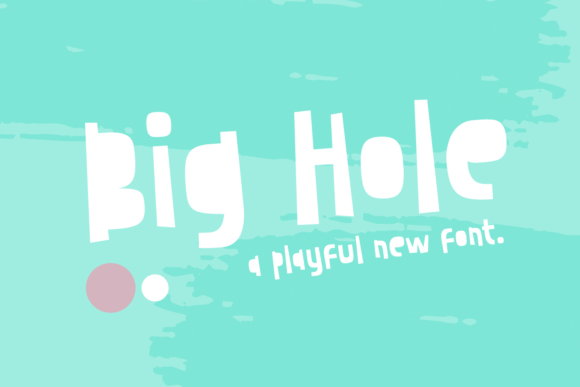
At its core, Big Hole is a display font that leans into boldness and charm. Its design features exaggerated strokes and irregular shapes that give it a handcrafted or spontaneous feel. This makes it ideal for projects where a sense of fun or lightheartedness is desired. Unlike more rigid or formal typefaces, Big Hole invites creativity and experimentation, allowing designers to push boundaries in their work.
The font’s name itself hints at its visual characteristics—there’s an intentional sense of openness and movement that gives it a distinct identity. This makes it particularly effective for headlines, logos, and other elements where visual impact is key. However, its use should be considered carefully, as its stylistic choices may not align with all design contexts.
Key Characteristics and Design Elements
Big Hole’s most notable feature is its unconventional structure. The letterforms often include gaps, asymmetry, and uneven weight distribution, which contribute to its whimsical appearance. These traits make it stand out in a crowded design landscape, but they also require thoughtful application to avoid overwhelming the viewer.
While the font lacks the precision of serif or sans-serif typefaces, it compensates with a strong visual presence. Its irregularities can evoke a sense of authenticity, making it well-suited for branding that aims to feel approachable or artisanal. Additionally, the font’s boldness ensures readability at larger sizes, though it may become less legible when used in extended text.
Designers working with Big Hole should consider how its characteristics align with the tone and message of their project. For instance, it might be an excellent fit for a children’s book cover, a creative agency logo, or a festival poster, but less appropriate for a corporate report or a financial document.
Practical Use Cases and Real-World Performance
Big Hole shines in scenarios where visual storytelling and emotional resonance are important. It can be used to create eye-catching headlines, social media graphics, or promotional materials that need to stand out. Its dynamic nature allows for creative compositions that break away from traditional typography norms.
In practice, the font performs best when used sparingly. Overuse can lead to a cluttered or chaotic appearance, especially in layouts with multiple typographic elements. Designers should balance Big Hole with more neutral fonts to maintain clarity and hierarchy. For example, pairing it with a clean sans-serif like Helvetica or Arial can help anchor the design while letting Big Hole take center stage for emphasis.
Another consideration is the font’s versatility across platforms. While it may render consistently on digital screens, its effectiveness in print depends on the quality of the output. High-resolution printing can enhance its details, but low-quality prints may diminish its intended impact. Users should test the font in their specific medium before finalizing a design.
Strengths and Limitations of Big Hole
One of Big Hole’s greatest strengths is its ability to convey emotion and personality through typography. It offers a refreshing alternative to standard fonts, allowing designers to express individuality and creativity. This makes it particularly valuable for projects that aim to connect with audiences on a more personal level.
However, its stylistic choices also come with limitations. The font’s irregularities may not appeal to all audiences, and its lack of uniformity could be seen as unprofessional in certain contexts. Additionally, its limited availability in different weights or styles may restrict its use in complex layouts that require variation.
For designers who prioritize originality and want to add a touch of playfulness to their work, Big Hole is a worthwhile addition to their toolkit. But for those seeking consistency and neutrality, it may not be the best choice.
Who Benefits Most from Using Big Hole?
Big Hole is particularly suited for creatives, marketers, and entrepreneurs who want to differentiate their work through typography. It can be a powerful tool for branding, especially for businesses targeting younger or more expressive audiences. Startups, independent artists, and small-scale publishers may find it useful for creating a memorable visual identity.
Freelancers and designers working on custom projects may also benefit from incorporating Big Hole into their portfolio. Its unique style can set their work apart and demonstrate their ability to think outside the box. Educators and content creators looking to engage students or readers with visually stimulating material could also find value in using this font.
That said, professionals in more conservative industries may find that Big Hole does not align with their brand’s tone. In such cases, it’s important to evaluate whether the font’s personality matches the intended message and audience expectations.
Recommendations for Effective Use
To get the most out of Big Hole, consider the following recommendations:
- Use it for headlines and short phrases: Big Hole excels in brief, impactful text where its visual appeal can shine without overwhelming the reader.
- Pair it with complementary fonts: Balance its uniqueness with simpler typefaces to maintain readability and structure.
- Test it in different contexts: Experiment with how it looks in both digital and print formats to ensure it meets your project’s requirements.
- Consider your audience: Assess whether the font’s playful style aligns with your target demographic and the message you want to convey.
By thoughtfully integrating Big Hole into their designs, users can leverage its distinctive qualities to create engaging and memorable visual experiences.
Final Thoughts on Big Hole
Big Hole is more than just a font—it’s a statement. Its whimsical design offers a fresh perspective on typography, appealing to those who want to infuse their work with creativity and personality. While it may not be suitable for every project, its strengths in visual impact and originality make it a valuable asset for the right audience.
Whether you’re designing a logo, crafting a marketing campaign, or exploring new creative directions, Big Hole provides a unique opportunity to express yourself through type. As with any design element, its success depends on how well it aligns with your goals, audience, and overall vision.