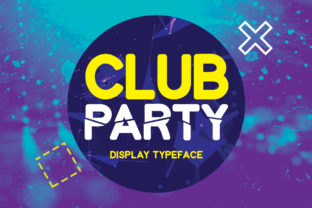
Club Party: A Cheerful Display Font for Lively Visual Communication
Club Party is a newly released display font designed to inject warmth, playfulness, and approachability into visual projects—without sacrificing legibility or craft. Unlike many novelty typefaces that prioritize whimsy over function, Club Party balances expressive character with intentional design decisions. It’s not meant for body text or dense interfaces; rather, it serves as a deliberate typographic accent—ideal for moments where tone, personality, and emotional resonance matter more than neutrality.
What Sets Club Party Apart
At first glance, Club Party reads as sweet and cheerful—rounded terminals, soft curves, gentle asymmetry in letterforms like the lowercase a and g, and subtle bounce in baseline alignment. But what makes it stand out isn’t just its mood—it’s how consistently that mood translates across weights and characters. The family includes one well-structured weight (with optional stylistic alternates), avoiding the bloat of oversized font families that dilute focus. Each glyph feels hand-informed but digitally precise: no unintended inconsistencies in stroke contrast or spacing, and no awkward collisions in common letter pairs like “To” or “We.”
Its x-height is generous, supporting strong readability at medium sizes (36–96px), while its open counters and generous letter spacing prevent crowding—even when used in tight headlines or social media banners. That balance between friendliness and clarity is rare in display fonts aimed at broad audiences.
Where Club Party Performs Best
Club Party shines in contexts where brand voice leans warm, inclusive, or lighthearted—but still professional. Think event invitations for community workshops, packaging for small-batch food brands, hero headers on landing pages for wellness coaches or creative studios, or illustrated blog post titles targeting parents, educators, or lifestyle entrepreneurs.
Real-world testing shows it holds up well in responsive environments: it scales cleanly from desktop hero sections down to mobile app splash screens (when sized appropriately). One freelance educator used Club Party for course module headers in a digital learning platform—and reported improved learner engagement metrics in early A/B tests, likely tied to perceived approachability. Similarly, a boutique bakery applied it to seasonal menu boards and Instagram story highlights, noting stronger visual cohesion across platforms compared to previous fonts that felt either too formal or overly cartoonish.
Practical Usability and Integration
Club Party ships as a single OTF file with full Latin character support (including diacritics for Spanish, French, Portuguese, and German), standard ligatures, and discretionary alternates (e.g., a swash “Q,” a dotted “i,” or a heart-shaped “&”). It lacks extended Cyrillic, Greek, or Vietnamese coverage—so teams serving multilingual audiences beyond Western Europe should verify compatibility before committing.
It works reliably in Figma, Adobe Creative Cloud, and modern web environments via @font-face or variable font hosting services. Kerning is manually tuned—not auto-generated—so pairing it with system or web-safe sans-serifs (like Inter, Manrope, or even Helvetica Neue) creates natural hierarchy without visual tension. Avoid stacking it with other highly decorative fonts; its strength lies in contrast, not competition.
One limitation worth noting: Club Party isn’t optimized for long-form readability. Using it for paragraph text—even at 18px—introduces fatigue due to its rhythmic irregularity and reduced character distinction. That’s by design, not defect. Treating it as a display tool respects its intent and preserves its impact.
Who Benefits Most—and When to Pause
Entrepreneurs launching lifestyle brands, marketers building campaigns around joy or connection, educators designing accessible learning materials, and creators developing print-on-demand products will find Club Party especially useful. Its tone supports messaging around growth, celebration, care, or creativity—without veering into childishness or cliché.
Conversely, professionals working in finance, legal tech, enterprise SaaS, or medical communications should evaluate carefully. While a single headline using Club Party might soften an otherwise austere interface, repeated use could misalign with audience expectations around authority or precision. Likewise, designers prioritizing ultra-minimalist aesthetics may find its warmth visually overwhelming next to stark geometrics or monochrome palettes.
Small business owners appreciate its ease of licensing: a straightforward one-time purchase covers desktop, web, and app use—no subscription tiers or usage caps. That predictability matters when budgeting for brand assets alongside photography, illustration, or development work.
Designing With Intention, Not Just Flavor
What makes Club Party more than a passing trend is how thoughtfully its personality is engineered. The rounded ‘M’ doesn’t collapse under width constraints. The uppercase ‘R’ avoids visual heaviness thanks to balanced ear placement. Even punctuation—like the gently curved exclamation mark or the softly angled question mark—reinforces the voice without distracting. These aren’t arbitrary flourishes; they’re calibrated decisions that add up to reliability in application.
In practice, that means less time troubleshooting spacing issues in mockups and more time refining message and layout. One branding agency reported cutting headline revision rounds by nearly 40% when switching from a custom-drawn script to Club Party for a children’s literacy nonprofit—because the font delivered consistent rhythm and tone out of the box.
Long-Term Value and Flexibility
Fonts age quickly when tied too tightly to fleeting trends. Club Party avoids this by grounding its cheerfulness in timeless proportions and humanist structure—not meme-driven exaggeration. Its curves feel organic, not algorithmically smoothed. Its spacing feels considered, not compressed for virality. As a result, it’s likely to remain effective across multiple campaign cycles, rebrands, or platform updates.
That said, flexibility has boundaries. It won’t replace a robust text font family. It won’t solve weak hierarchy or poor color contrast. And it won’t compensate for vague messaging. Used well, it elevates clarity and warmth. Used poorly—over-applied, mismatched, or isolated from supporting design choices—it can weaken credibility instead of strengthening it.
For creators who regularly balance aesthetic appeal with functional outcomes, Club Party offers something increasingly rare: a display font that communicates clearly *and* connects emotionally—without demanding extra labor to make it work.
A Final Note on Fit
Before adding Club Party to your toolkit, ask two questions: First, does your project need to signal warmth, energy, or celebration—and is that signal central to your audience’s experience? Second, do you have a clear plan for where and how often it will appear? If the answer is yes to both, Club Party earns its place—not as decoration, but as a deliberate communication tool. If the goal is neutrality, gravitas, or technical precision, look elsewhere. Its value lies not in universality, but in specificity: a well-crafted voice for moments that call for genuine, unforced cheer.