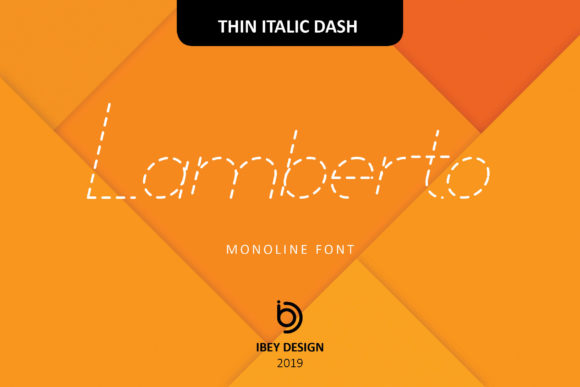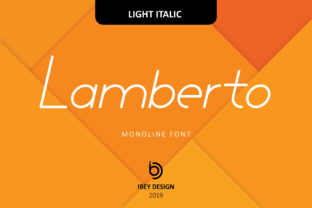
Lamberto Light Italic Dash: Where Typographic Confidence Meets Contemporary Clarity
Typography is no longer just about legibility—it’s about intention. In a landscape saturated with visual noise, where attention spans contract and brand authenticity is non-negotiable, typefaces have evolved from silent tools into strategic assets. Among the most compelling recent arrivals in this shift is Lamberto Light Italic Dash: a monoline display font that redefines boldness not through weight or ornamentation, but through precision, rhythm, and quiet authority.
A Typeface Designed for Impact Without Compromise
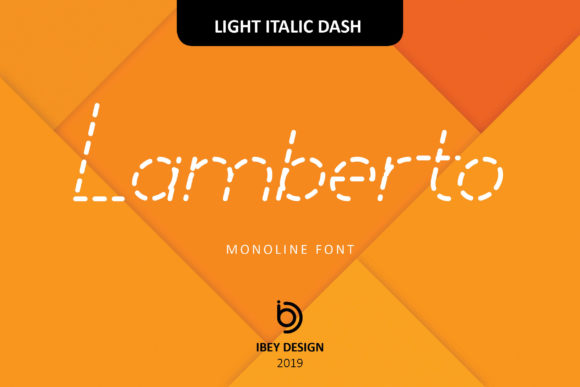
Lamberto Light Italic Dash belongs to the monoline family—meaning its strokes maintain consistent thickness across all characters—but it diverges sharply from minimalist conventions. Its italic construction isn’t merely slanted; it’s dynamically angled, with elongated terminals and purposeful, almost architectural, dash-like extensions on select glyphs (notably the a, f, g, and t). These dashes aren’t decorative flourishes—they’re functional punctuation marks built into the letterforms themselves, reinforcing motion, direction, and modernity.
Unlike many “light” fonts that risk fading into background roles, Lamberto Light Italic Dash commands presence. Its light weight avoids visual fatigue, while its italic energy ensures dynamism. It thrives at scale—on digital banners, editorial mastheads, product packaging, and immersive installations—yet remains legible and expressive even in constrained UI contexts like mobile navigation labels or app onboarding screens.
Why Designers and Brands Are Turning to Lamberto Light Italic Dash Now
The timing of Lamberto Light Italic Dash’s emergence aligns precisely with three converging shifts across creative and commercial practice:
- The rise of typographic minimalism with maximal personality — Audiences increasingly reject sterile neutrality. They respond to type that feels human-made yet rigorously considered. Lamberto Light Italic Dash delivers restraint without coldness—its subtle irregularities (like the asymmetric curve of the lowercase e or the tapered exit stroke of the r) suggest hand-informed craft, not algorithmic uniformity.
- The demand for typographic versatility across platforms — With content flowing seamlessly from social feeds to AR interfaces to physical signage, brands need type systems that retain identity across formats. Because Lamberto Light Italic Dash is built as a display face—not a text face—it’s optimized for recognition, not dense reading. That makes it ideal for logos, headlines, and micro-interactions where instant comprehension matters more than paragraph flow.
- The growing expectation of ethical, intentional design — Consumers and collaborators alike are attuned to how design choices reflect values. A font like Lamberto Light Italic Dash signals clarity, confidence, and contemporary fluency—not trend-chasing, but trend-clarifying. It doesn’t shout; it states. That resonates deeply with professionals who prioritize substance over spectacle.
Real-World Resonance: How It Fits Into Evolving Workflows
Consider a freelance brand strategist developing an identity system for a climate-tech startup. She needs typography that conveys both scientific rigor and forward-looking optimism. Choosing Lamberto Light Italic Dash for the logo and campaign headlines communicates innovation without gimmickry—its monoline structure suggests precision engineering, while its italic dash elements imply momentum and directionality. When paired with a robust, neutral sans-serif for body copy (like Inter or IBM Plex Sans), the contrast feels deliberate, not arbitrary.
Or take a marketing director launching a new SaaS platform. Her team is building a design system that must scale across documentation, dashboards, and customer-facing landing pages. Rather than defaulting to overused “tech fonts,” she selects Lamberto Light Italic Dash for section headers and feature callouts. Its consistent stroke width ensures crisp rendering on low-DPI screens and print collateral alike—and because it’s inherently display-oriented, it avoids the common pitfall of using a headline font in body contexts where readability suffers.
Even in experiential design, the font proves adaptable. An exhibition designer recently used Lamberto Light Italic Dash for wall-mounted quotes in a museum installation exploring urban resilience. The font’s lightness prevented visual heaviness in an already dense spatial environment, while its italic energy subtly echoed the theme of adaptive movement—reinforcing narrative without illustration.
Not Just Aesthetic—A Strategic Alignment
What distinguishes Lamberto Light Italic Dash from other contemporary display fonts is its refusal to rely on novelty alone. Its design logic is rooted in longstanding typographic principles—proportion, spacing, contrast—but interpreted through a distinctly current lens. The “dash” motif, for instance, echoes mid-century Swiss signage and Japanese kana stroke endings—yet feels entirely fresh in execution. This kind of cross-historical fluency gives it longevity: it won’t date quickly because it doesn’t chase trends—it synthesizes them.
Moreover, its monoline construction supports accessibility goals. Consistent stroke weight improves screen rendering at small sizes, and its open counters (the enclosed spaces within letters like a, e, and o) enhance character distinction—critical for users relying on screen readers or navigating via keyboard focus. In an era where inclusive design is both ethical and regulatory imperative, these attributes aren’t incidental—they’re essential.
Broader Context: Typography as Cultural Signal
Typefaces are cultural artifacts. They absorb and reflect the values of their moment. The popularity of Lamberto Light Italic Dash signals a broader recalibration: away from hyper-polished, AI-generated uniformity and toward human-inflected clarity. It arrives alongside renewed interest in analog workflows, tactile materials, and intentional slowness—not as nostalgia, but as counterbalance.
This mirrors developments in adjacent fields. In software development, frameworks like Svelte and Qwik emphasize efficiency *without* abstraction—prioritizing developer experience and end-user performance in equal measure. In sustainable fashion, designers favor mono-material constructions that simplify recycling and extend lifecycle. Similarly, Lamberto Light Italic Dash achieves sophistication through reduction—not by removing features, but by distilling them to their most resonant form.
For entrepreneurs launching direct-to-consumer brands, this matters profoundly. A font like Lamberto Light Italic Dash helps communicate craftsmanship in a digital-first context—where trust is earned through consistency, not claims. Its presence on a website header, email subject line, or unboxing insert creates continuity across touchpoints, reinforcing reliability without repetition.
Practical Integration Tips for Professionals
Introducing Lamberto Light Italic Dash into your toolkit doesn’t require overhauling your entire system. Start strategically:
- Anchor your hierarchy: Use it exclusively for H1s and primary CTAs—never for body text or captions. Its strength lies in declaration, not exposition.
- Respect its spacing: Its generous default sidebearings are intentional. Tightening tracking too aggressively undermines its rhythmic balance. Let it breathe.
- Pair with purpose: Complement it with a highly legible, true-neutral sans-serif (avoid “friendly” or “rounded” variants unless they serve a specific brand voice). Think IBM Plex Sans, Work Sans, or Manrope.
- Test across contexts: View it on OLED, e-ink, and matte-print surfaces. Its monoline nature ensures fidelity—but verify dash endpoints render crisply at your smallest intended size (no smaller than 24px for web, 8pt for print).
Finally, remember: Lamberto Light Italic Dash is not a solution looking for a problem. It’s a response—to the need for clarity amid complexity, for distinction without distortion, for confidence expressed quietly. In a world where every pixel competes for meaning, choosing a typeface is one of the most consequential design decisions you’ll make. And when that choice embodies intention, intelligence, and understated power, it does far more than label—it affirms.
That’s why Lamberto Light Italic Dash isn’t just another font release. It’s a marker of where thoughtful design is headed: precise, principled, and unforgettably present.