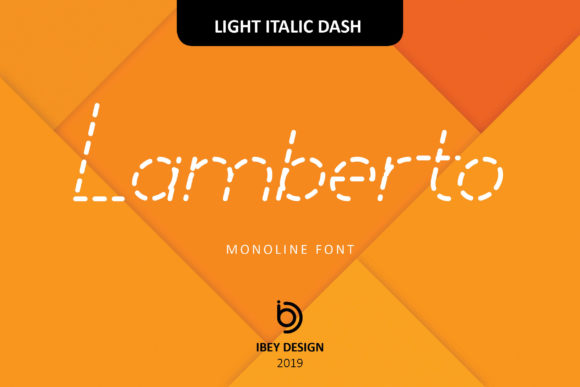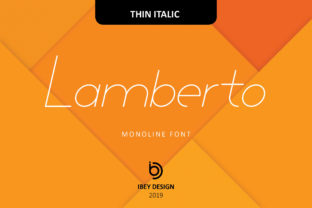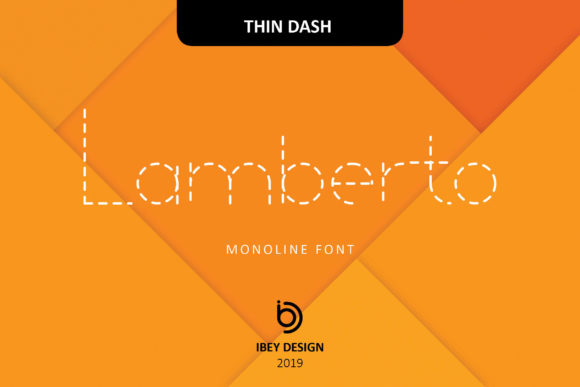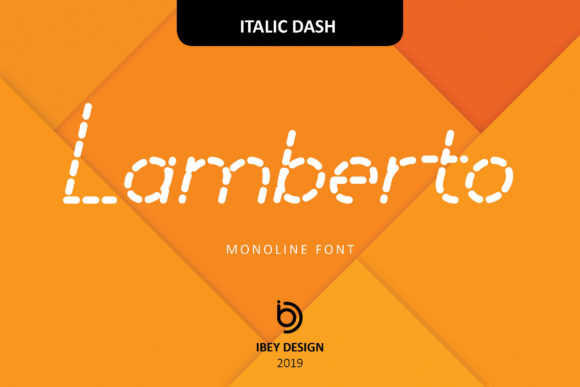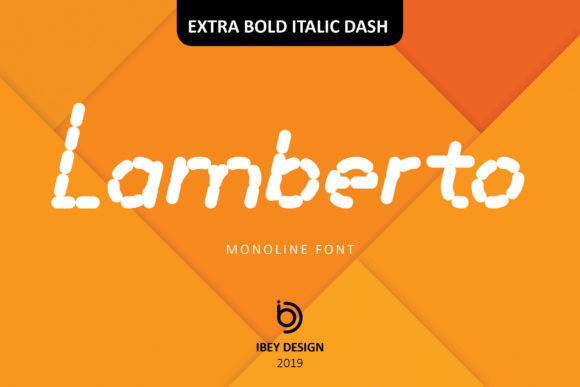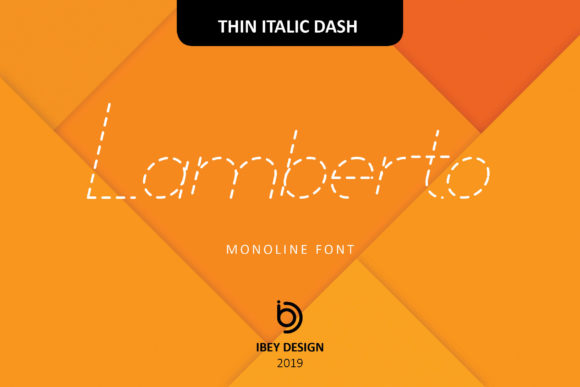
Lamberto Thin Italic Dash: Where Precision Meets Bold Intent
Typography isn’t just about legibility—it’s about attitude, timing, and tone. When a brand needs to project confidence without shouting, elegance without fuss, or modernity without coldness, designers often reach for something that feels both refined and unmistakably current. That’s where Lamberto Thin Italic Dash steps in—not as background filler, but as a deliberate, decisive voice.
A Monoline Statement With Dimension
At first glance, Lamberto Thin Italic Dash appears deceptively simple: a monoline display font with consistent stroke weight, clean terminals, and an unmistakable slant. But simplicity here is strategic—not minimalism for its own sake, but clarity engineered for impact. Unlike variable-weight families that rely on contrast to create hierarchy, Lamberto Thin Italic Dash builds presence through posture, spacing, and rhythm.
The italic angle isn’t exaggerated—it’s calibrated. Around 12–14 degrees, it leans forward with purpose, suggesting motion and intention without sacrificing stability. Paired with its upright sibling, Lamberto Thin Dash, the two form a tightly knit typographic duo ideal for branding systems that demand visual cohesion across static and dynamic contexts—think logo lockups, social avatars, app splash screens, or even animated headlines.
Why “Thin” Doesn’t Mean “Fragile”
“Thin” in the name might raise eyebrows—especially when used for display purposes. But in Lamberto Thin Italic Dash, thinness functions like a laser beam: focused, precise, and capable of cutting through visual noise. Its x-height is generous, letterforms are open, and counters are carefully tuned—so even at small sizes (down to 24px in UI contexts), readability holds up. That’s rare for a font this slender.
This resilience makes it viable beyond posters and billboards. You’ll see it working effectively in:
- Mobile-first interfaces—as headline typography in news apps or premium subscription onboarding flows;
- Luxury e-commerce—labeling limited-edition product drops or editorial banners where whitespace and restraint signal exclusivity;
- Editorial design—introducing chapter titles in digital magazines or long-form newsletters where tone matters as much as content.
Crucially, Lamberto Thin Italic Dash doesn’t ask for special treatment. It performs well across rendering engines—from Safari’s WebKit to Chrome’s Blink—and handles subpixel antialiasing gracefully on both Retina and legacy displays. No font-smoothing hacks required.
How It Fits Into Real Design Workflows
Designers don’t pick fonts in isolation—they test them inside real projects. Lamberto Thin Italic Dash shines when integrated into systems that value consistency *and* flexibility. For example:
- Brand identity systems: A fashion label uses Lamberto Thin Dash for its logotype and Lamberto Thin Italic Dash for campaign taglines—creating instant recognition while allowing expressive variation. The italic isn’t decorative; it’s functional emphasis, guiding the eye without altering the core identity.
- Web development handoff: Developers appreciate that Lamberto Thin Italic Dash ships with robust OpenType features—including discretionary ligatures and stylistic alternates—but defaults to clean, predictable behavior without requiring complex CSS font-feature-settings. It loads fast, renders reliably, and scales cleanly via
font-sizeandline-height. - Content strategy alignment: When a brand pivots toward more conversational, human-centered copy, Lamberto Thin Italic Dash supports that shift. Its slight warmth—evident in the subtle curve of the ‘a’, the soft entry stroke of the ‘c’, the balanced asymmetry of the ‘e’—keeps tone approachable, even when set large and bold in all caps.
Pairing It Without Overcomplicating
One of the most common questions designers ask isn’t “What does it do?” but “What goes with it?” Lamberto Thin Italic Dash thrives alongside typefaces that ground rather than compete. Think neutral sans-serifs with low contrast and open apertures—like Inter, Manrope, or even a restrained cut of Helvetica Now. Avoid pairing it with other high-contrast or heavily modulated italics; the result can feel cluttered or tonally mismatched.
For print or high-fidelity digital use, try setting body text in a warm-textured serif (e.g., Literata or PT Serif) while reserving Lamberto Thin Italic Dash for pull quotes, section dividers, or callout boxes. Its monoline nature creates a satisfying visual counterpoint to serifs with organic stress and modulation.
And yes—it works beautifully with color. Because of its even weight distribution, Lamberto Thin Italic Dash maintains integrity whether set in deep charcoal, electric cobalt, or soft blush. Gradient fills? Subtle. Underlines? Clean and unobtrusive. Letter-spacing adjustments? Responsive and intuitive—even at negative values down to –30 units for tight, impactful wordmarks.
Practical Considerations Before You Commit
Like any strong typographic choice, Lamberto Thin Italic Dash invites thoughtful evaluation—not just aesthetic preference. Here’s what to weigh:
- Licensing scope: Confirm whether your intended use—be it SaaS dashboard, client brochure, or merchandise—is covered under the license tier you’re purchasing. Some versions include web, desktop, and app usage; others require add-ons for extended use cases like video or broadcast.
- Language support: Lamberto Thin Italic Dash covers Latin-based languages comprehensively—including extended diacritics for French, Spanish, Polish, Turkish, and Vietnamese. If your audience includes Greek or Cyrillic readers, verify coverage before finalizing.
- File format readiness: It ships in modern WOFF2 and variable TTF formats, making it production-ready for responsive sites. But if you’re supporting IE11 or older Android WebView, plan fallbacks—its elegance depends on consistent rendering.
- Accessibility alignment: While not a text font, Lamberto Thin Italic Dash meets WCAG contrast guidelines when paired with appropriate background colors (minimum 4.5:1 for 24px+ text). Just avoid using it for interface labels smaller than 18px without testing with real users.
When Lamberto Thin Italic Dash Becomes the Right Choice
It’s not for every project. You wouldn’t use it for a government health portal’s instruction manual—or a children’s literacy app. But in contexts where tone, timing, and perception matter intensely, it delivers outsized value.
Imagine launching a new creative studio. Your website’s hero section needs to say “We think differently”—not with a loud slab serif or a playful script, but with something taut, intelligent, and quietly assured. Lamberto Thin Italic Dash says that in one line of type.
Or picture a wellness brand introducing a mindfulness podcast. Instead of overused serenity fonts, they choose Lamberto Thin Italic Dash for episode titles—clean enough to breathe, italic enough to suggest inward movement, thin enough to feel light without feeling insubstantial.
That’s the quiet power of this family: it doesn’t dominate attention—it earns it. And in a world saturated with visual noise, that kind of earned attention is increasingly rare—and increasingly valuable.
Final Thought: Typography as Intention Made Visible
Lamberto Thin Italic Dash isn’t just another display font. It’s a tool for signaling intent before a single word is read. Its monoline structure removes distraction. Its italic slant adds direction. Its thinness asserts confidence—not in volume, but in precision.
When you choose Lamberto Thin Italic Dash, you’re not selecting a style—you’re committing to a stance: clarity over clutter, intention over inertia, and quiet strength over forced impact. And in today’s design landscape, that’s not just practical. It’s essential.